
AOL Account Types: Unlock Better AOL Mail Options and Powerful Features in 2026


AOL Account Types: Unlock Better AOL Mail Options and Powerful Features in 2026
Choosing the right email account can make everyday communication, account management, and online organization easier. With different AOL account types available or discussed online, users may come across new accounts, older accounts, phone-verified accounts, and different account options. Understanding these differences is useful before deciding which type suits a particular purpose.
AOL Mail accounts continue to provide familiar email functionality for users who want an established email service. However, an account should not be judged only by its age or verification status. Security, recovery access, account history, available features, and compliance with AOL’s applicable rules are also important.This guide explores the major AOL account types, their characteristics, important AOL account features, and the factors users should compare before choosing an account option in 2026.
Common AOL Account Types
There are several AOL account types that users may encounter when researching email accounts. The most common distinction is between newly created accounts and accounts with a longer history. Some listings may also describe accounts as phone-verified or PVA accounts.
Understanding these categories can help users avoid making a decision based solely on marketing terminology. AOL account types can have different histories and characteristics, but terminology used by third-party providers may not always describe an official AOL product category.
Understanding the Main Account Categories
New accounts are generally recently created profiles with limited account history. In comparison, aged AOL accounts are typically described according to the length of time an account has existed.
AOL PVA accounts generally refers to accounts described as phone-verified. Verification can provide an additional account-management detail, but it should not automatically be interpreted as a guarantee of security, trust, or continued access.
When comparing AOL account types, users should look beyond labels and examine the actual account characteristics.
Key Differences Between Account Options
The main differences between AOL account types may involve account age, account history, recovery information, verification status, and available settings.
For AOL Mail accounts, practical considerations such as access, password control, recovery options, and security settings can be more meaningful than a simple account label.
New AOL Accounts
New AOL accounts are accounts that have been created relatively recently. They can be suitable for users who simply want a fresh email address for personal communication, registrations, organization, or other legitimate purposes.
Among the different AOL account types, new accounts generally have the shortest history. This does not necessarily mean that they have fewer standard email functions.
What to Know About Newly Created Accounts
A new account may have little or no historical activity. Users should therefore spend time configuring security and recovery information appropriately.
When evaluating AOL account types, a new account can be understood primarily through its current settings rather than assumptions about its future performance.
Users should also make sure their activities comply with applicable AOL policies. Creating or using an account for legitimate communication is different from using accounts for deceptive, abusive, or prohibited activity.
Important Features to Review
When setting up AOL Mail accounts, review available security and recovery settings. A strong password, appropriate recovery information, and awareness of unusual sign-in activity can contribute to better account management.
The most useful AOL account features are those that help users communicate, organize messages, manage contacts, and maintain control over account security.

Aged AOL Accounts
Aged AOL accounts are accounts commonly described as having existed for a particular period. The term “aged” generally refers to account age rather than a separate official AOL account product.
Among the different AOL account types, older accounts may have a longer historical record. However, age alone does not explain how actively an account was used or whether its historical information is reliable.
Understanding Account History
Account history can provide context, but it should not be treated as a guarantee of account quality. An account that has existed for several years may have had very little activity during that period.
Therefore, users comparing AOL account types should distinguish between account age and account activity.
For example, an account that has existed for three years is not necessarily more useful than a newer account simply because of its age. Other factors, including security, recovery access, current functionality, and legitimate ownership, remain important.
What Account Age Can and Cannot Tell You
Account age can indicate how long an account has existed. It cannot automatically confirm the account’s reputation, activity level, security, or future availability.
This is one of the most important points to understand when researching aged AOL accounts. A longer history should not replace careful account management.
Among AOL account types, aged accounts should therefore be evaluated using several factors rather than age alone.
AOL PVA Accounts
AOL PVA accounts is a term commonly used to describe accounts associated with phone verification. PVA usually means “Phone Verified Account” in online account terminology.
Phone verification may be part of an account’s history or setup, but users should understand exactly what verification means before drawing conclusions about an account.
Understanding Phone-Verified Accounts
A phone-verified account may have been associated with a telephone number during an applicable verification process. The availability and requirements of verification features can change over time.
When reviewing AOL account types, users should not assume that phone verification means an account is permanently trusted or protected from security checks.
Verification and account security are separate considerations.
Verification and Security Considerations
Security remains important regardless of the AOL account types being considered. Users should understand who controls the recovery information and whether they can maintain appropriate access to the account.
For AOL PVA accounts, verification status should therefore be treated as one characteristic rather than the only factor that matters.Reviewing AOL Account Security Help can help users understand account protection and recovery options.
Users should also avoid relying on accounts for activity that violates platform rules or involves misleading behavior.
AOL Account Features
Understanding AOL account features is essential when comparing different AOL account types. Features can influence how conveniently users communicate, organize information, and maintain account security.
AOL Mail accounts are primarily associated with email communication, but account management also involves settings, contacts, security, and recovery options.
Mail and Account Management Tools
Email management features can help users organize incoming and outgoing messages efficiently. Depending on the current AOL service and account configuration, users may have access to tools for organizing messages, managing contacts, and adjusting account preferences.
When reviewing AOL account types, consider whether the available features match the intended legitimate use.
Security and Recovery Features
Security should be a central part of evaluating AOL account features. Users should understand password controls, recovery information, authentication options, and sign-in activity where available.
A useful AOL account types comparison should therefore include security and recovery rather than focusing only on account age.
Accessibility and Convenience Options
Convenience features can also influence the overall experience. Users may want to consider how easily they can access their mailbox, organize messages, manage contacts, and adjust account settings.
These practical AOL account features can be more relevant to everyday users than labels such as “new,” “aged,” or “PVA.”
What to Compare
When comparing AOL account types, it is helpful to use a consistent checklist. Looking at several factors can provide a clearer understanding of what an account actually offers.
Account History and Availability
Account history can be useful for understanding how long an account has existed. However, users should avoid assuming that age automatically means better performance.
For aged AOL accounts, ask what the stated age actually represents and whether the information can be verified appropriately.
Security and Recovery Information
Security is one of the most important areas to review across all AOL account types.
Check whether appropriate recovery information is available and whether the account can be secured and managed properly. Unclear recovery arrangements can create access problems later.
Features and Account Control
Review the available AOL account features and determine whether the account provides the functionality required for legitimate use.
Account control is particularly important. Users should understand what information they can manage and what access mechanisms are available.
Provider Transparency and Policies
If users encounter third-party descriptions of AOL Mail accounts, they should carefully review the provider’s information and terms. Claims about account age, verification, activity, or features should not automatically be accepted without clarification.
Users should also review AOL’s current terms and policies before using an account for any activity.
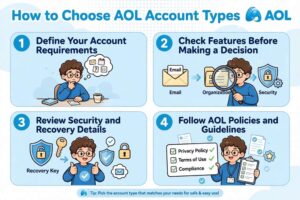
How to Choose
Selecting among AOL account types should begin with the user’s actual requirements. There is no single characteristic that determines whether an account is suitable.
Define Your Account Requirements
First, identify why you need the account. A person who wants ordinary email communication may have very different requirements from someone managing several legitimate communication channels.
Understanding your purpose makes it easier to evaluate the relevant AOL account types.
Check Features Before Making a Decision
Compare the actual AOL account features rather than relying on account labels. Look at email functionality, organization tools, security settings, and recovery options.
A newer account with appropriate security controls may meet a user’s needs better than an older account with unclear access arrangements.
Review Security and Recovery Details
Security should always remain a priority. Regardless of which AOL account types you consider, make sure you understand how access can be maintained and recovered.
For AOL Mail accounts, recovery information is particularly important because losing access to an email account can affect other services connected to that address.
Follow AOL Policies and Guidelines
All AOL account types should be used responsibly and according to applicable platform rules. Account age, verification, or other characteristics do not create an exemption from those requirements.
Before using AOL PVA accounts, aged accounts, or new accounts, users should make sure their intended activities are legitimate and compliant.
Why AOL Account Types Matter in 2026
The growing number of online accounts means users need to think carefully about security, access, and account management. Understanding AOL account types can help users interpret terminology and avoid making decisions based on a single feature.
AOL Mail accounts can serve ordinary communication needs, while terms such as aged AOL accounts and AOL PVA accounts describe characteristics that users may encounter in online discussions or third-party listings.
The key is to separate marketing terminology from practical account characteristics.
A good comparison of AOL account types considers account history, current functionality, security, recovery, and responsible use together.
FAQ
What are the main AOL account types?
Commonly discussed AOL account types include new accounts, aged accounts, and accounts described as phone-verified. These labels may describe characteristics rather than separate official AOL products.
What are AOL Mail accounts used for?
AOL Mail accounts can be used for ordinary email communication, message organization, contact management, and other available account functions.
What are aged AOL accounts?
Aged AOL accounts are generally described as accounts that have existed for a longer period. Account age alone does not establish activity, security, or account quality.
What does PVA mean?
AOL PVA accounts generally refers to accounts described as phone-verified accounts. Verification status should not be treated as a guarantee of security or permanent access.
Which AOL account features should I compare?
Important AOL account features to review include email functionality, account settings, security options, recovery information, and available management tools.
Does account age guarantee better performance?
No. Among different AOL account types, account age is only one characteristic. Current security, access, account history, and intended use should also be considered.
Why is account recovery important?
Recovery options can help users regain access if they forget credentials or experience an account-access problem. This makes recovery an important consideration for all AOL Mail accounts.
Conclusion
Understanding AOL account types is a useful starting point for making informed account-management decisions in 2026. New accounts, aged AOL accounts, and AOL PVA accounts may differ in characteristics, but no single label tells the complete story.
When comparing AOL Mail accounts, pay attention to account history, security, recovery information, available AOL account features, and legitimate intended use. Avoid treating account age or verification as a substitute for proper security.
Ultimately, the right way to evaluate AOL account types is to look beyond the label and understand the actual features, controls, history, and policies associated with the account.